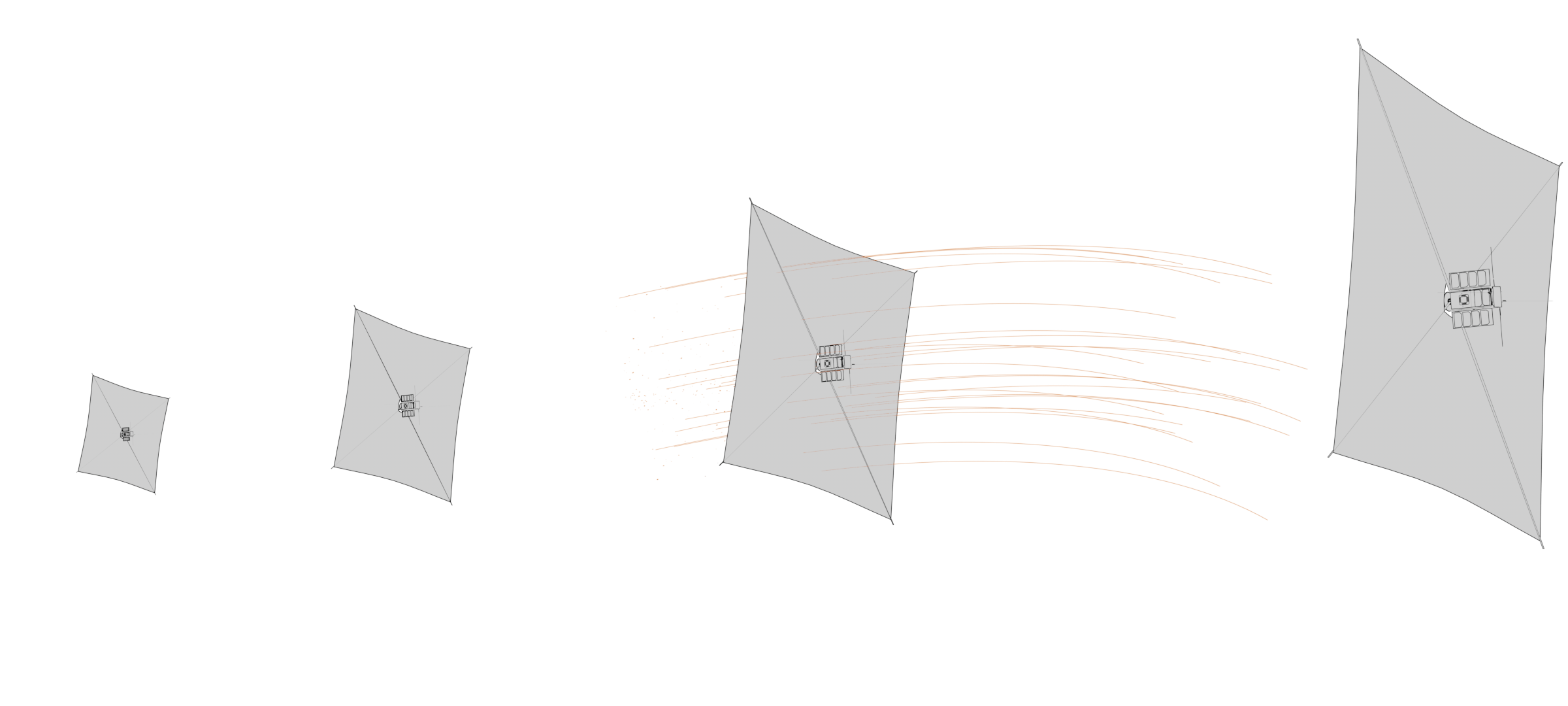
Odin's technology starts at the spacecraft and builds outward. Sensors installed on individual satellites collect precise impact data. That data feeds into a growing network that maps the orbital environment with a resolution that has never existed before. The result is an intelligence layer that serves operators, insurers, and defense agencies with information they cannot get anywhere else.
The Odin Network is a growing community of spacecraft generating on-orbit sensor data that is unavailable anywhere else.
As more spacecraft join, the network grows in value, providing anonymised insight to support decisions before launch and during operations, well beyond what any single spacecraft can offer. Every asset equipped with Odin sensors contributes to a collective intelligence about the orbital debris environment. The more that participate, the clearer the picture becomes.
The network exists and grows with every customer deployment. The intelligence it produces feeds directly into the Odin platform, where operators access risk reports, monitor their fleet, and plan based on current data rather than models built from data collected over twenty years ago.
Odin Nano Sensors are the core hardware. Compact enough to install on virtually any spacecraft with a self-adhesive application that requires minimal modification. Each unit contains purpose-built impact detectors that translate the moment of contact into precise diagnostic data, enabling triangulation and forensic characterisation.
Detect projectiles down to 0.1 mm in size
Timestamps of when spacecraft is hit
Identify where on the spacecraft was struck
Verify how much damage was caused
80x12x4 mm
Per sensor
170g
Total system mass
1.2 W
Peak power draw
RS-485/RS-422
Standard protocols and connectors
Sensors attach with a peel-and-stick adhesive and connect through standard data interfaces. No custom engineering or structural modifications required.
Available in nano-D and micro-D configurations, compatible with standard protocols.
Qualified for outgassing, EMI, and radiation tolerance to NASA and ESA standards. Sensors have flown on the SpaceX Transporter-8 mission, demonstrating proven performance in orbit.

Odin alerts you the moment your threat environment changes, so you can see a hazard developing and decide whether to maneuver. Today that call is made blind. Ground-based tracking sees objects 10 cm and larger. Odin detects impacts from fragments a fraction of a millimeter wide, on the satellite itself, in real time. No other commercial system can do that.

Ground radar can track debris down to roughly 10 cm. Space-based optical pushes that to about 1 cm. Both miss the fragments small enough to evade detection but large enough to end a mission. Odin detects impacts down to 0.1 mm, on the satellite itself, the moment they happen.
.png)


This 3.2-millimeter-thick aluminum plate was punctured by a single plastic projectile the size of a large salt crystal traveling 5 kilometers per second.

The holes in this 3-millimeter-thick aluminum plate were made by sub-millimeter particles, roughly the size of a grain of salt, impacting at a fraction of orbital speeds.
Odin Outposts are dedicated sensing platforms positioned at strategic orbital checkpoints. They provide persistent monitoring of corridors and regions where the cost of getting it wrong is highest, serving mega-constellations, defense operators, and infrastructure where human life or critical assets are involved.
Deploy a constellation of Outposts across a single orbit and they function as an always-on early warning system, detecting new threats as they emerge and alerting every operator in that corridor. Built on the same core sensing technology as the Nano Sensors, Outposts are scaled up and deployed independently of customer spacecraft.