Why do satellites fail? And why do we so rarely find out?
August 27, 2026
When a satellite stops working in orbit, the people who built it often cannot say why. It loses power, or simply goes quiet. The telemetry offers no clear culprit. A team will spend weeks combing through the data and file the anomaly as cause unknown.
This is not a rare outcome. In a review of 866 small satellites launched between 1990 and 2019, researchers at the University of Luxembourg and LuxSpace found that failures in a satellite's first month are attributed to a cause a little over half the time. The record only worsens from there. Of the failures that occur within a satellite's first five years, four in five have no attributed cause.[^1] The pattern is the opposite of what you might expect. As a spacecraft ages past its early manufacturing faults, the ones that show up neatly in telemetry, its failures become harder to explain, not easier.
The same study carries one more number. Across the entire record, a collision or debris strike is almost never positively identified as the cause: the study's catch-all category that includes them never contributes more than 1.5 percent of failures at any point in a satellite's life.[^1] The data cannot say whether impacts are rare or simply almost never identified, because conventional satellites generally carry no dedicated instrument capable of resolving the question.
For most of the space age this was a tolerable mystery. There were not many satellites, and each was watched closely by the few agencies that could afford to fly them. That era is over.
The crowded sky
The number of active satellites has more than doubled since 2021; the European Space Agency now counts around 16,000 working spacecraft in orbit. In 2024 alone the world launched roughly 2,800 more,[^6] most into low Earth orbit, the busy band of space a few hundred kilometers up. A single operator, SpaceX's Starlink, accounts for the majority of everything working up there.
The growth is not simply more of the same; it has come in waves. Earth-observation startups put up the first modern fleets of small satellites, a scatter of companies photographing the planet from above. Broadband followed, with a handful of giants lofting satellites by the thousand. A third wave is now taking shape, and it is odder than the first two: companies are filing plans for orbital data centers and for factories that would exploit weightlessness, each wave larger than the last.
More hardware packed into the same narrow shells means things come closer to hitting each other, more often. You can watch the pressure build in the avoidance figures. In the first half of 2023, Starlink satellites performed about 25,000 maneuvers to dodge other objects. Two years later, over a comparable six-month stretch, the figure was around 144,000.[^2]
A swarm nobody can see
Those maneuvers only avoid what can be seen. Space-surveillance networks maintain catalog data on roughly 46,000 objects, and ESA estimates around 54,000 objects larger than ten centimeters are in orbit in total. Below that size the record thins out fast, because routine tracking from the ground becomes progressively harder. Models put the number of fragments smaller than one centimeter at upwards of 130 million. And the danger threshold sits far below even that familiar benchmark. Across Odin's operator assessments to date, the smallest particle capable of penetrating the bus and causing an anomaly or failure has typically been around half a millimeter, the size of a grain of table salt (0.48 mm), with some spacecraft vulnerable down to 0.3 mm. None of them can be tracked, and none can be dodged.
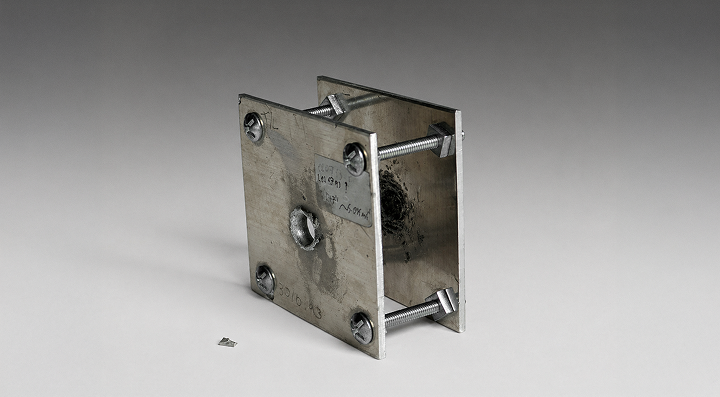
Set the two facts side by side: the most dangerous objects in orbit are ones no instrument can see coming, and the most common verdict on a failed satellite is one nobody can name. It is tempting to connect the dots and declare debris the culprit. Untracked impact is one plausible cause of unexplained failures, and it is the cause that current spacecraft diagnostics are least equipped to confirm or rule out. From the ground, a debris strike looks identical to a power fault or a software error: the satellite simply stops. One industry study estimates that more than 95 percent of the collision risk capable of ending a mission comes from debris too small to track.[^3] Whether that risk is what actually felled any particular satellite is exactly the question the industry cannot answer.
Clear evidence: the rare case
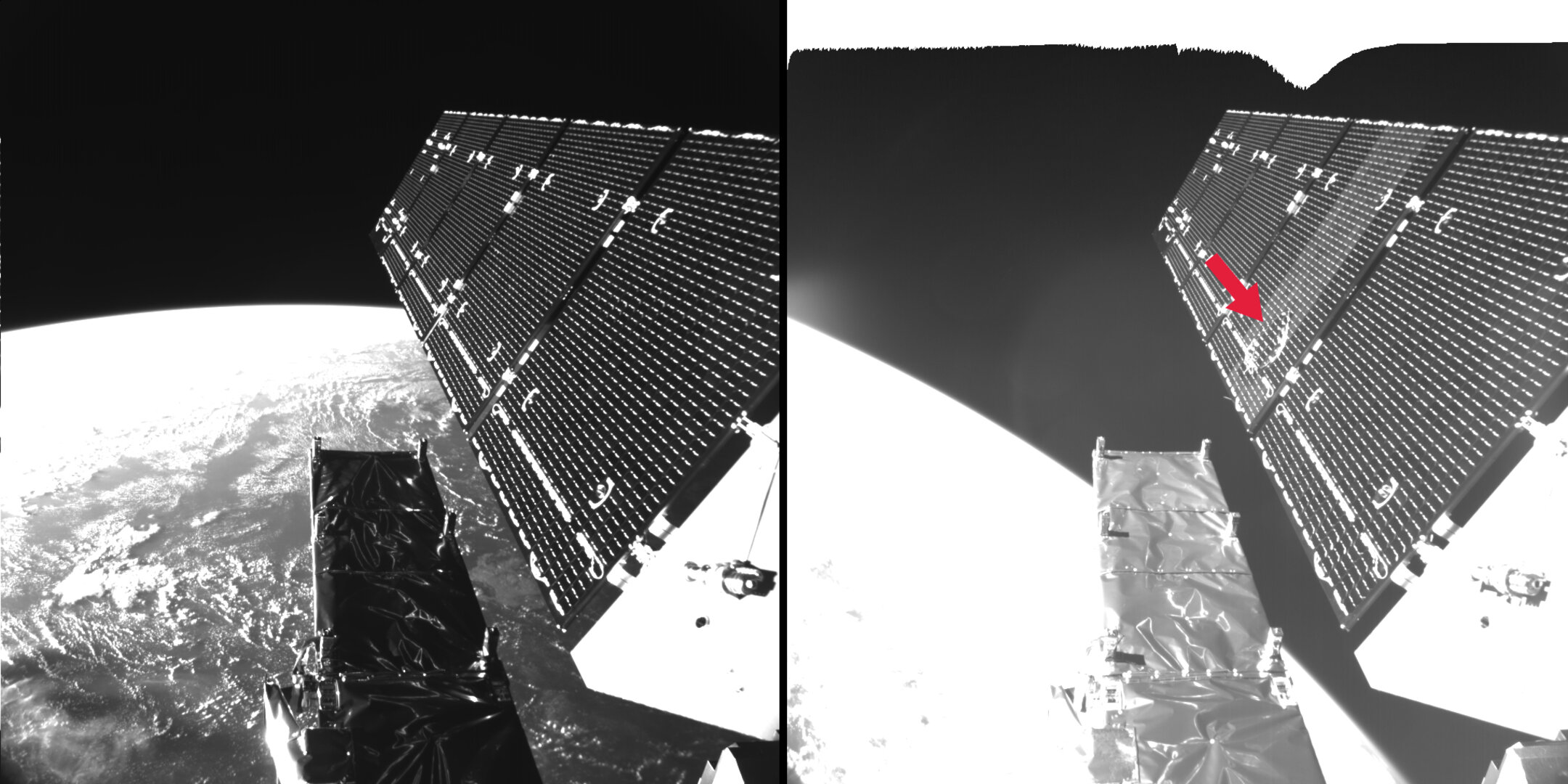
The clearest reconstruction we have came by luck. In 2016 a European radar satellite, Sentinel-1A, took a sudden hit to one of its solar wings. Engineers could establish what had happened only because the spacecraft carried a camera that could be turned on its own panel, and the pictures showed a damaged patch roughly 40 centimeters across. ESA's technical analysis put the impactor at around a centimeter across, far too small for any ground station to have seen it coming.[^4] Very few satellites carry that kind of self-inspection.
Usually the evidence is thinner and the bill much larger. In late 2025 a Spanish military communications satellite, SpainSat NG II, was climbing toward its final orbit when it was hit by something. The operator attributed the loss to an impact from an untracked object. The damage was not recoverable, and the spacecraft, insured for around $400 million, was written off. There is no fragment to examine and no radar track to consult. That is the current state of the art in orbital failure investigation.
What the blind spot costs
You cannot price a risk you cannot measure, and the insurance market shows the strain. Only around one in twenty satellites in low Earth orbit carries insurance for its working life; the rest fly uncovered, and not always by choice.[^5] For operators who do seek cover, the process is slow and the price is steep. Underwriting can take the better part of a year, and for hardware without flight heritage, cover may not be offered at all. Where it is, the premium can run into millions of dollars, partly because underwriters are pricing unproven hardware with no data on how often satellites are actually being struck. Underwriters aren’t struggling to price the satellite. They’re struggling to price the thing that kills it. Until collision damage can be separated cleanly from every other way a satellite can die, there is little for an underwriter to price.
The blind spot follows manufacturers too. When a satellite fails without explanation, the hardware often remains under suspicion by default, and that suspicion follows the builder into every future contract and insurance conversation. Impact evidence cuts both ways in a useful direction: if it was debris, it was not the hardware.
A black box for spacecraft
This is the gap Odin Space works on. Every commercial aircraft carries a flight recorder. Almost no satellite does. The Odin Black Box is a compact sensor unit mounted on the host spacecraft, and the name is meant literally: it is built to tell you what happened when something goes wrong. Its impact instrument establishes that an external strike occurred, where on the structure it happened, and how severe it was. The data reaches the operator through Odin Overwatch, Odin's monitoring and intelligence service.
The scope is deliberately narrow. The Black Box does not diagnose software faults or power anomalies; radiation and thermal degradation are equally outside its remit. What it settles is the first question an operator or an insurer needs answered: was this an impact, or something else? Today that question is asked and rarely settled. With impact data, it becomes a diagnosis, and the diagnosis ripples outward. Were sibling spacecraft in the same plane exposed to the same debris? Does the next design need more shielding, or was this an outlier? And for the insurance market, it supplies a named peril, objectively evidenced, that can be separated from every other cause of failure and priced on its own.
Space is going to keep filling up, and a collision today seeds the debris environment of the 2030s. The real question is whether the industry flies the next decade as blind as it flew the last.
Odin Space builds the intelligence layer for orbital impact, the evidence operators and insurers have never had. Contact us to find out more.
Odin Space provides in-orbit impact data and does not underwrite insurance. Collision cover referenced here is underwritten at Lloyd's of London by Atrium and arranged through the broker WTW.
[^1]: Perumal, R.P., Voos, H., Dalla Vedova, F., & Moser, H. "Small Satellite Reliability: A Decade in Review." SSC21-WKIII-02, 35th Annual Small Satellite Conference, 2021. Dataset: 866 satellites of 40–500 kg, 1990–2019. Unknown-cause share of cumulative failures: 44% by 30 days in orbit, 60% by one year, 80% by five years (Table 12). Collision and debris strikes are grouped under "Other," which contributes at most 1.5% at any point.
[^2]: SpaceX, Semi-Annual Constellation Status Reports to the FCC, via Space.com and Space Intel Report.
[^3]: HDI Global Specialty, space debris study, 2023: more than 95% of mission-terminating collisional risk is attributed to lethal non-trackable debris.
[^4]: Krag, H., et al., analysis of the Sentinel-1A solar array impact, Acta Astronautica, 2017.
[^5]: HDI Global Specialty (2023): roughly 6% of LEO spacecraft carry in-orbit insurance, against about half of GEO satellites. Industry-wide, roughly 300 of ~12,800 active satellites carry in-orbit cover (David Wade, Atrium Space Insurance Consortium, 2024).
[^6]: BryceTech, "Smallsats by the Numbers 2025" (~2,790 smallsats launched in 2024); Jonathan McDowell, planet4589.org (2,863 payloads launched in 2024).